Fruits Basket with Flowers
A Real-World Designer’s First Look at This Redwork-Inspired Embroidery File
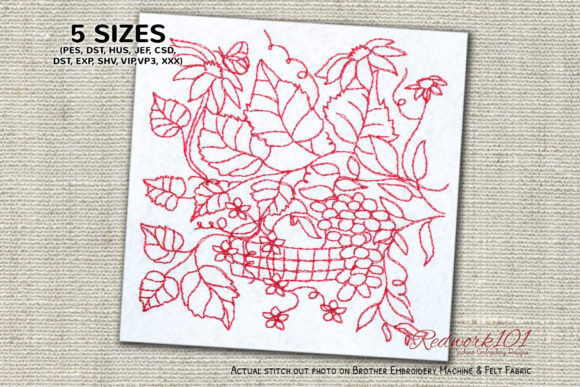
As someone who’s stitched hundreds of designs for client projects—custom tote bags for local cafés, baby onesies for Etsy shops, and embroidered tea towels for boutique kitchen lines—I opened Fruits Basket with Flowers expecting charm, but not quite this kind of quiet confidence. It’s a Forest-themed embroidery file that leans into redwork tradition: clean outlines, intentional negative space, and botanical rhythm without fuss. No photorealism, no overworked petals—just apples, pears, grapes, and wildflowers arranged in a loose, hand-drawn basket. The mood? Warm, approachable, quietly nostalgic—like a handwritten recipe card passed down through generations.
Where It Shines: Real Projects That Feel Like They Belong
I tested Fruits Basket with Flowers on a natural linen tea towel first—no lining, no backing, just medium-weight fabric and standard tear-away stabilizer. The result was crisp, breathable, and unmistakably handmade. That’s where this design earns its keep: in products where authenticity matters more than flash. Think aprons for small-batch bakeries, pillow covers for nursery decor, or sweatshirt pockets for eco-conscious apparel brands. It also translated beautifully onto a cotton-blend baby blanket—soft enough to hold up to gentle washing, detailed enough to invite touch and recognition.
For Etsy sellers and craft fair vendors, Fruits Basket with Flowers works as both a standalone piece and a subtle brand anchor. I used it as the central motif on a set of three matching kitchen towels (each with a different fruit highlighted in thread), and customers consistently commented on how “cohesive but not matchy” the set felt. That’s rare—and valuable—for a digital embroidery file sold as a single download.
What You’ll Notice When Stitching It Out
- The Box Stitch is truly optional—and smartly so. In my test on a curved cap front, I skipped it entirely. The basket shape held its integrity without the outer frame, and the design read cleaner at smaller scale.
- Stitch density feels balanced: no heavy fill-stitch jungles or fragile running-stitch stems. The leaves use open satin stitch, the fruits rely on smooth outlines with light fill, and the flowers are built from layered running stitches—not dense clusters that could pucker thin fabrics.
- No tiny lettering or micro-details to snag on textured weaves. That means fewer re-hooping moments on terry cloth towels or looped cotton caps.
Where to Use It Thoughtfully (Not Just Everywhere)
This isn’t a one-size-fits-all embroidery file—and that’s a strength, not a limitation. Here’s where I’d pause before pressing “start”:
- Stretchy fabric—like lightweight jersey tees—needs extra stabilizer underlay and possibly reduced tension. The basket’s open structure can distort if the base fabric gives too much.
- Dark or heavily textured backgrounds—the redwork style depends on contrast. On charcoal fleece or bouclé wool, test thread colors first. A deep burgundy or charcoal-gray thread often reads truer than classic red.
- Caps and curved surfaces—the top curve of the basket works well near a crown seam, but avoid placing the full design across the front panel’s widest arc unless you’ve confirmed hoop clearance and fabric stretch.
- Frequent-wash items—like kids’ bibs or dishcloths—benefit from reinforcing the stem ends with a few extra lock stitches. The design doesn’t include them by default, so add manually if needed.
How It Shapes Perception—Before and After Stitching
Customers don’t buy embroidery files—they buy finished products they trust, recognize, and feel proud to give or wear. Fruits Basket with Flowers supports that trust because it looks intentionally designed, not algorithmically generated. There’s breathing room between elements. The fruit sizes vary naturally. The vines curl with slight asymmetry. That translates directly to perceived value: a handmade product that feels considered, not copied.
For small shop owners, it reinforces brand consistency without demanding rigid repetition. You can pair it with neutral typography on packaging, use it as a subtle watermark on printable mockups, or adapt one element—say, just the grape cluster—as a repeating border on a custom patch. It’s flexible, but never generic.
Practical Notes Every Designer Should Check Before Sending to Hoop
- Test on scrap fabric first—especially if using non-standard thread (metallic, variegated, or matte cotton).
- Review stitch order: does the basket outline lay down before the fruits? If not, adjust to avoid stitching over delicate stems.
- Confirm hoop size compatibility: the design spreads comfortably within a 5x7 hoop, but check your machine’s native limit—some compact models require scaling or splitting.
- Inspect small details at actual stitch size: zoom in on the flower centers and vine tips. Are they legible at 3 inches wide? If not, simplify before commercial use.
- Run black-and-white mockups to verify contrast on both light and dark fabric previews—critical for Etsy listing visuals.
- Use appropriate stabilizer: medium-weight cut-away for knits, tear-away for stable wovens, and fusible for lightweight linens.
- Verify licensing terms before selling finished items or bundling Fruits Basket with Flowers into a larger digital embroidery collection. Some Forest-themed files restrict resale of derivative assets.
Final Thought: A Design That Serves the Project, Not the Other Way Around
Fruits Basket with Flowers doesn’t shout. It settles in. It complements a linen apron without competing with the fabric’s texture. It softens a structured sweatshirt without fading into background noise. And for creative entrepreneurs—whether launching a holiday embroidery kit or refreshing their craft fair lineup—it offers reliable, recognizable warmth. Not every embroidery file needs to be bold or complex to earn its place in your design assets. Sometimes, the most effective machine embroidery design is the one that simply feels like it belongs—right where you put it.