Wooden Cart with Flower Redwork
A Rustic, Handmade First Impression That Builds Trust
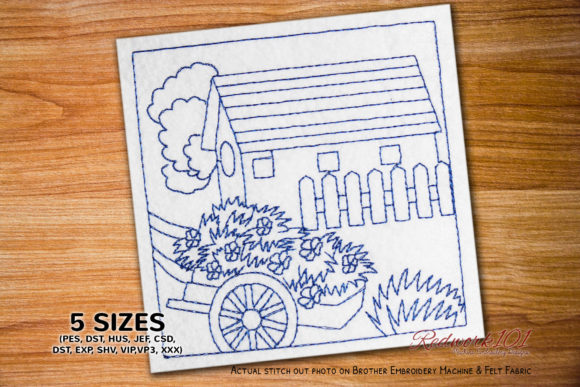
As an embroidery designer who’s developed hundreds of commercial designs for small businesses, my first read on Wooden Cart with Flower Redwork is immediate and positive: it reads as warm, approachable, and authentically handmade—without sacrificing clarity or structure. The composition—a wooden cart overflowing with flowers, a house in the foreground, trees behind—evokes pastoral charm and quiet craftsmanship. It’s not overly ornate, nor is it minimal to the point of abstraction. That balance makes it ideal for brands rooted in community, care, and tactile quality: think local bakeries, florists, farm-to-table cafés, indie craft studios, and handmade pet accessory lines.
Strong Performance Across Real Small Business Merchandise
Wooden Cart with Flower Redwork shines where many decorative embroidery files falter: on functional branded items. As an embroidered patch, it holds its shape beautifully at 2.5”–3.5” widths—ideal for apron corners, tote bag flaps, or uniform chest accents. Its layered elements (cart, flowers, house, trees) are distinct enough to read at a glance but cohesive enough to feel intentional—not cluttered. On caps, it works best centered on the front panel when sized to 2” height; the vertical flow of the cart and floral mass anchors the design naturally. For tote bags and work shirts, it scales cleanly up to 4”, retaining legibility without requiring excessive stitch density.
For custom apparel like staff uniforms or boutique merchandise, this design supports brand storytelling without demanding attention. It doesn’t shout—it invites. That subtlety builds trust: customers associate the gentle rural motif with authenticity, sustainability, and care—qualities that elevate perceived product value. Etsy sellers and crafters especially benefit, since Wooden Cart with Flower Redwork reinforces a handmade product narrative while still feeling polished enough for premium packaging accents or customer thank-you gifts.
Where to Use It Thoughtfully—And Where to Pause
This design excels on stable, medium-weight fabrics like cotton twill, canvas, and denim—but requires careful planning on curved or textured surfaces. Avoid placing it directly over seams, elbows, or cap crowns unless you’ve tested hooping and stabilizer support thoroughly. On dark uniforms (navy, charcoal, forest green), verify thread color contrast: redwork traditionally uses high-contrast reds, but ensure your chosen red pops against the base fabric after washing and wear.
Small patch sizes under 2” demand caution. While the cart and house remain readable, fine floral details may blur or fill in during digitizing—especially if the original embroidery file lacks optimized underlay or clean satin edges. Likewise, avoid using it on highly textured fabrics (like heavy burlap or looped terry) without aggressive cutaway stabilizer and reduced stitch density. And remember: the optional Box Stitch framing adds visual weight but also increases stitch count—factor that into production time and cost for high-volume orders.
How It Strengthens Brand Identity and Customer Connection
For small businesses, consistency is credibility—and Wooden Cart with Flower Redwork delivers visual continuity across touchpoints. Used as an apron embroidery motif, a cap embroidery accent, and a tote bag design, it creates a unified handmade aesthetic without needing matching fonts or logos. That cohesion signals professionalism: customers recognize your brand not just by name, but by tone, texture, and intention.
It also deepens engagement. A café using this design on staff aprons and reusable totes subtly communicates values—local sourcing, seasonal beauty, human-scale production. That resonance translates to repeat visits, social shares, and word-of-mouth referrals. Unlike generic icons or stock motifs, Wooden Cart with Flower Redwork feels curated, not copied. That distinction matters in crowded markets like Farm-themed retail or artisanal food branding.
Practical Embroidery Designer Notes for Commercial Use
Before committing to production, run these checks:
- Test in black and white first—verify silhouette strength and negative space balance without color distraction.
- Check small patch viability at 2” width on your target fabric; adjust density or simplify stems if needed.
- Review thread color contrast, especially for redwork tones—some reds fade or dull on certain fabrics after laundering.
- Inspect spacing between cart, house, and trees; tight gaps may merge during stitching without proper underlay.
- Confirm hoop size compatibility—if the design exceeds standard 4”x4” hoops, plan for re-hooping or larger-capacity machines.
- Test on real fabric with correct stabilizer: medium-weight cutaway for structured items (patches, caps), tear-away for lightweight totes or aprons.
- Create a printable mockup for client approval—show it scaled on actual product photos, not just white backgrounds.
- Compare it beside other design assets (logos, typography, secondary icons) to ensure visual harmony in your full brand system.
- Verify commercial licensing before use—since this is a digital embroidery file intended for small business merch, confirm it permits unlimited production runs, resale, and derivative use.
A Timeless Fit for Farm, Craft, and Community-Centered Brands
Wooden Cart with Flower Redwork isn’t just another machine embroidery design—it’s a versatile, emotionally resonant asset for businesses that lead with heart and hands-on integrity. Whether applied as an embroidered patch on a florist’s delivery tote or stitched onto the sleeve of a bakery’s staff shirt, it quietly affirms values customers want to support. Its Farm-rooted charm never feels dated, and its Embroidery-ready structure ensures reliability across commercial projects. For small business owners and embroidery shops alike, this design earns its place—not as decoration, but as deliberate, meaningful brand language.