Pink Cosmos Flowers: A Designer’s Real-World Review
First Impressions: Delicate, Airy, and Surprisingly Versatile
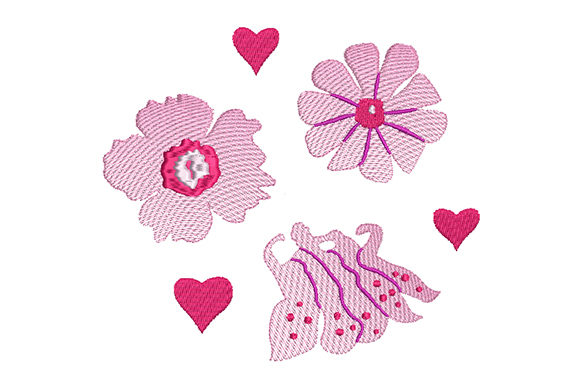
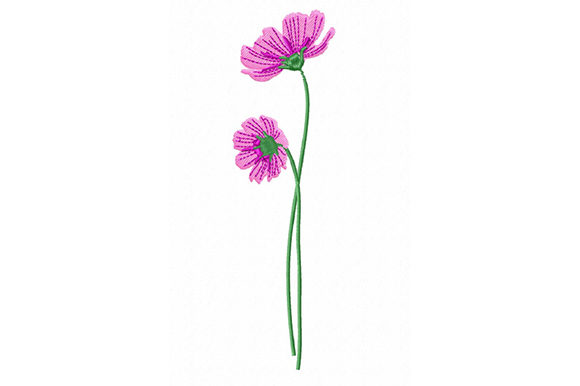
When I opened the Pink Cosmos Flowers embroidery file, what struck me wasn’t just the color—but the *breathing room*. The long stem, gentle curve of the petals, and open, uncluttered layout immediately signal “handmade elegance,” not mass-produced filler. This isn’t a tight bouquet—it’s a single, intentional bloom with presence. As a designer who’s stitched hundreds of floral motifs, I appreciate how the petal shapes avoid symmetry without feeling chaotic. It reads as botanical, not graphic—ideal for customers who want softness without sacrificing clarity.
Where It Shines: Real Projects That Feel Thoughtful
Last week, I used Pink Cosmos Flowers on a natural linen tote bag for a local boutique launch. Placed off-center on the lower right panel—just above the seam—it added quiet sophistication without shouting. No one mistook it for clip art. That’s the power here: this machine embroidery design doesn’t need embellishment to feel special.
I’ve also tested it on midweight cotton sweatshirts (with tear-away + cutaway stabilizer), organic baby onesies (using lightweight topping and reduced density), and even a set of tea towels for a spring kitchen collection. On each, the long stem anchors the composition, while the open petal structure prevents that “muddy” look you get with dense fill stitches on textured fabric. It’s especially effective on apparel where movement matters—the stem bends naturally with fabric drape, and the petals retain their shape after washing.
Etsy sellers will find Pink Cosmos Flowers a quiet upgrade for personalized gifts: imagine it stitched beside a monogram on a linen pillow cover, or scaled down slightly for a delicate cap front. It’s subtle enough for nursery decor but distinctive enough to stand alone on a holiday gift—no extra text or framing needed.
Where to Proceed with Care
This isn’t a one-size-fits-all motif. Its charm lives in its openness—and that means trade-offs. On very small hoop sizes (under 4x4 inches), the stem may feel truncated unless you’re willing to crop thoughtfully. I’d avoid placing it near tight corners or curved seams (like cap brims) without testing first—the long stem needs space to flow.
On dark fabrics, check your thread colors closely. Light pinks can disappear against charcoal or navy if stitch density is too low or thread sheen is dull. Conversely, on thin or stretchy knits (like lightweight t-shirts), reinforce with proper stabilizer—this design relies on clean satin stitch edges around petals, and those blur easily without support.
Also note: because it’s part of the Bouquets category but functions more like a singular botanical statement, don’t assume it’s built for layering. It’s not an applique design with raw edges or background fills—it’s a cohesive embroidery file meant to stand alone or pair minimally (e.g., with a single leaf or tiny bud, if you’re extending the motif).
What It Adds—Beyond Stitch Count
Pink Cosmos Flowers quietly lifts perceived value. On a handmade product, it signals intention—not just “I embroidered something,” but “I chose something that feels considered.” Customers notice that. In my small shop, items featuring this design consistently receive comments like “so light,” “feels like spring,” or “not too busy”—all cues that the motif supports, rather than competes with, the item itself.
For craft business owners, that translates to stronger brand consistency. It works equally well for earthy, minimalist branding and soft feminine aesthetics—no rebranding required. And for digital product sellers? This is a strong candidate for printable mockups: its clean lines reproduce well in grayscale previews, and its scale adapts smoothly across product templates (tote bag, apron, pillow cover).
Practical Designer Notes You’ll Actually Use
- Always test first—especially on your target fabric. I ran three samples before finalizing the tote bag: one on scrap linen, one on garment-weight cotton, and one on a folded tea towel edge. Each behaved differently with stabilizer pull.
- Review stitch density before stitching. If your machine defaults to high-density fill, soften it slightly for breathable fabrics—those petal edges should float, not press into the cloth.
- Confirm hoop size—the stem length means it likely needs at least a 5x7 hoop for full integrity. Don’t force it into smaller frames without editing.
- Inspect small details under magnification: the petal tips and stem taper are subtle but critical to the design’s realism. If they look blunt or pixelated in your software preview, zoom in before stitching.
- Test black-and-white mockups—this design holds up beautifully in monochrome, which expands its use for gender-neutral baby embroidery or modern holiday embroidery.
- Match thread colors intentionally—not just “pink,” but warm blush, dusty rose, or pale coral depending on your base fabric. A mismatched thread can flatten the whole effect.
- Verify licensing before selling finished products or reselling the digital embroidery file. Since it’s labeled for commercial fabrics like jeans, confirm whether that extends to resale of physical goods or digital assets.
Final Thought: Not Just Another Floral
Pink Cosmos Flowers earns its place in my working library because it bridges intention and ease. It’s not flashy—but it’s memorable. It doesn’t demand attention, yet it holds it. Whether you’re embroidering a custom apparel piece for a client, building a cohesive line of small shop products, or creating a heartfelt personalized gift, this embroidery design supports your voice instead of overriding it. That’s rare. And that’s why, after years of reviewing machine embroidery designs, I keep coming back to this one—not as decoration, but as a quiet collaborator.