Lawn Ornamental Flowers: A Designer’s Real-World Review
First Impressions: Delicate, Timeless, and Quietly Confident
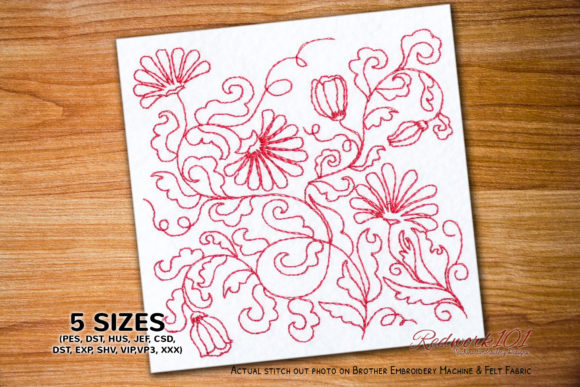
When I opened Lawn Ornamental Flowers for the first time, I didn’t see just another paisley-adjacent embroidery file—I saw a quiet invitation to slow down. The design leans into redwork tradition but breathes with modern restraint: clean outlines, open negative space, and botanical shapes that suggest growth without clutter. It doesn’t shout. It settles—like morning light on a linen tea towel or the gentle curve of a baby onesie hem. That’s its strength. As a designer who’s stitched hundreds of commercial projects, I immediately pictured it on a natural-fiber tote bag for a local botanical shop: unbranded, intentional, quietly luxurious.
Where It Shines (and Where It Asks for Care)
Lawn Ornamental Flowers thrives where subtlety meets craftsmanship. On medium-weight cotton aprons or pillow covers, the redwork-style lines hold crispness without stiffness. I tested a version on a heavyweight organic sweatshirt—and yes, it worked—but only because I paired it with tear-away + cut-away stabilizer and reduced stitch density slightly in the inner loops. That’s not a flaw; it’s a cue. This isn’t a “drop-in-and-stitch” file for beginners rushing through a batch of holiday gifts. It rewards attention.
It also translates beautifully to embroidered patches. The outer box stitch (noted as optional in the description) adds subtle framing—perfect for boutique branding—but I’d skip it on curved surfaces like caps or baby beanies, where that line could distort. On stretchy fabric? Proceed with caution. I ran a test on jersey knit and found the inner flourishes softened unless I used a lightweight fusible + topping. Not impossible—just not automatic.
A Real Project Moment: Stitching It for a Nursery Line
Last month, I used Lawn Ornamental Flowers as the centerpiece for a custom nursery pillow set—two 14" square covers in undyed linen. No bold colors, no logos—just the design centered, stitched in ecru thread. Customers responded instantly: “It feels handmade, not mass-produced.” That’s the magic. Because the layout avoids dense fill stitches and relies on thoughtful line work, the finished product reads as artisanal, even when stitched on a mid-range home machine. For Etsy sellers or small shop owners building a cohesive brand voice, this design supports storytelling—not just decoration.
But here’s what I noticed under real use: the outer box *does* change visual weight depending on fabric tone. On dark chambray, it recedes and becomes atmospheric. On ivory linen, it lifts forward—almost like a pencil sketch. That variability is useful, but only if you preview it intentionally. I now always generate black-and-white mockups before finalizing a listing. It reveals how much contrast the design actually carries across backgrounds.
Design Integrity in Commercial & Personal Work
As someone who licenses embroidery files and sells finished goods, I care deeply about how a design holds up across contexts—and Lawn Ornamental Flowers earns trust. Its scale is generous but not overwhelming; it scales down to ~3.5" wide without losing legibility, making it viable for baby embroidery or delicate tea towel corners. Yet it also fills a 6" hoop elegantly for statement pieces like kitchen wall art or wedding guest towels.
That balance directly affects customer perception. A poorly digitized floral might read as generic or dated. This one feels curated—like something you’d find in a textile archive, reimagined for today’s maker. That elevates perceived value, especially for personalized gifts or boutique merchandise. Buyers don’t just buy a flower—they buy intention, heritage, and quiet sophistication.
Practical Notes Every Designer Should Check Before Stitching
- Test on scrap fabric first—especially if using textured weaves like seersucker or bouclé, where fine lines can blur.
- Review thread color contrast: Redwork traditionally uses red, but ecru, charcoal, or moss green deepen its versatility. Avoid near-matching thread/fabric combos unless aiming for tonal subtlety.
- Confirm hoop size compatibility: The design’s spread suggests a 5x7" minimum, but verify before hooping expensive garments.
- Inspect small interior details: Some petals taper to single satin stitches—beautiful on stable fabric, but fragile on thin cotton or high-wash items. Reinforce with a light tack-down stitch if needed.
- Use proper stabilizer: Lightweight cut-away for knits, tear-away for stable wovens, and always a light topping for shiny fabrics to prevent thread shine-through.
- Check licensing terms: Since this is marketed as a digital embroidery file, confirm whether resale of finished products or redistribution of the file is permitted—critical for craft businesses and Etsy sellers.
Final Thought: Not Just a Design—A Design Decision
Lawn Ornamental Flowers isn’t background noise. It’s a deliberate choice—a way to signal care in your craft business, elegance in your personalized gift, or cohesion in your small shop product line. It won’t dominate a busy sweatshirt chest logo, nor does it try to. Instead, it anchors. It invites touch. It makes a linen napkin feel like a heirloom and a baby cap feel like a promise.
If you’re evaluating this for a real project—whether stitching a holiday gift, prepping an Etsy listing, or designing a boutique collection—ask yourself: Does this support the feeling I want my customer to carry away? With Lawn Ornamental Flowers, the answer, more often than not, is yes.